







What is a golf launch monitor?
Understand how golf launch monitors work and why measurement technology matters.
 Trackman Editorial Team
A golf launch monitor is a device that measures the physical data of your golf shot — capturing what happens at the moment of impact and tracking what the ball does afterwards. The data it produces covers parameters like ball speed, launch angle, spin rate, carry distance, club path, face angle, and more than 40 additional data points depending on the system.
Players, coaches, club fitters, and equipment manufacturers use launch monitors to understand performance objectively — replacing guesswork with measurable facts.
How does a golf launch monitor work?
There are two primary technologies used in launch monitors today: radar and optical (camera-based) systems.
Radar-based systems track the ball continuously from impact through the full ball flight — measuring real velocity, trajectory, and aerodynamic behavior across the entire shot. The data is measured, not estimated.
Optical systems capture a fraction of a second at impact using high-speed cameras, then use algorithms to predict what the ball would have done based on those measurements. The quality of those predictions depends entirely on the reference data the algorithms were trained on.
This distinction matters more than most people realize — particularly for indoor use, where the ball flight cannot be observed in full. A radar-based system trained on billions of measured full ball flights produces more reliable indoor predictions than an optical system whose models have never observed a complete trajectory.
When searching for the best golf launch monitor available on the market, it’s important to take several key factors into consideration.
Why every major tour independently chose radar
When organizations with the most to lose from inaccurate data choose a measurement technology, that choice matters.
PGA Tour has used Trackman as the core of its ShotLink ball-tracking system for over two decades, renewing through 2030 with 36 radar units capturing every shot in competition.
DP World Tour named Trackman its Official Launch Monitor and Official Ball Tracing Technology in a three-year agreement signed in 2025.
LPGA Tour partnered with Trackman as a central part of its new broadcast era beginning 2026.
LIV Golf expanded to a comprehensive multi-year partnership with Trackman providing radar units on all 18 tee boxes at every global event.
The R&A has validated Trackman technology through multiple accuracy assessments, with its Chief Scientist confirming confidence in the system.
None of these organizations have a marketing motive. They chose the same technology independently because accurate data is core to their operations.
Why equipment manufacturers build around radar accuracy
Perhaps the most telling signal of where the industry's engineering trust lies comes from the golf ball manufacturers themselves.
Titleist spent three years developing RCT (Radar Capture Technology) golf balls — embedding radar-reflective material inside their Pro V1 and Pro V1x — specifically to enhance the accuracy of radar-based launch monitors indoors. The RCT balls have been validated against Trackman 4.
TaylorMade independently developed TRK-R golf balls using liquid silver embedded beneath the cover to improve radar signal capture. After testing thousands of shots in partnership with Trackman, TRK-R received Trackman's full certification for accurate indoor data.
Two competing manufacturers, each investing years of R&D to make their premium balls perform better with radar-based measurement. Neither created an equivalent product optimized for optical systems.

Trackman 4: The outdoor standard
Originally developed for tour professionals and elite coaches, Trackman 4 uses dual radar synchronized with camera-based OERT (Optically Enhanced Radar Tracking) technology to deliver more than 40 data parameters with unmatched precision.
The dual radar system operates at 40,000 samples per second, tracking the ball from impact through its complete trajectory — measuring real aerodynamic behavior rather than modeling it. A second short-range radar captures club and impact data with a pickup rate exceeding 90% across all shot types.
Because Trackman 4 has measured billions of real, complete ball flights across every club type, swing speed, spin rate, and weather condition, the reference dataset underlying its models is grounded in measured reality. This is the foundation on which all indoor predictions are built.
Trackman 4 is used by more tour professionals than any other launch monitor, trusted by the world's leading coaches and club fitters, and chosen by every major professional golf organization as their official measurement technology.
Trackman iO: Purpose-built for indoor use
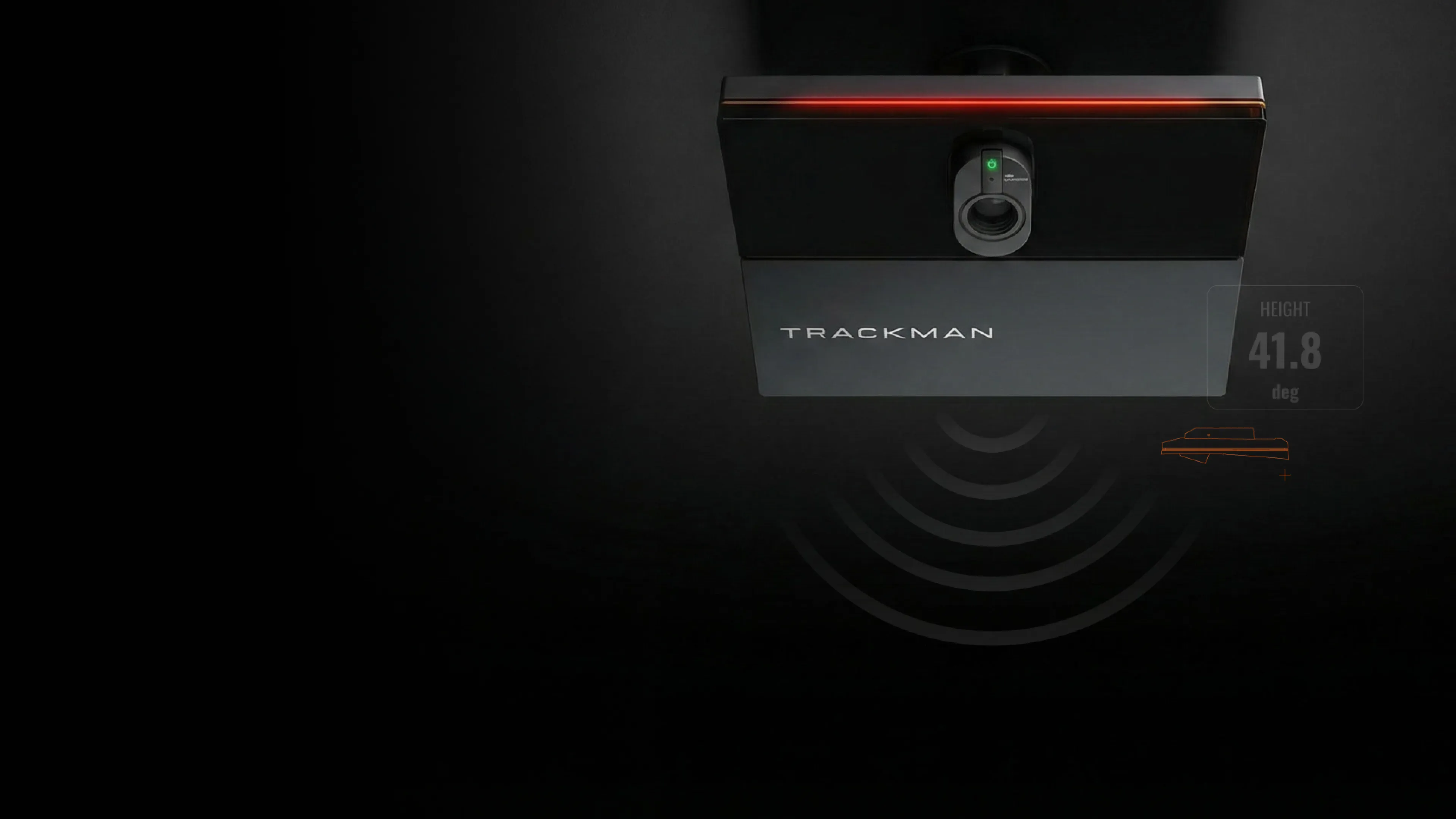
For golfers building home simulators or operating indoor facilities, Trackman iO is the purpose-built indoor solution. Ceiling-mounted and requiring minimal space with no extra lighting, the iO combines radar and dual camera technology optimized specifically for short indoor distances.
The ceiling-mount design provides a fundamentally different — and cleaner — line of sight to the club-ball interaction than any floor-based system. No markers on ball or club are required.
Because Trackman iO's indoor predictions are built on the same reference dataset as Trackman 4 — billions of measured full ball flights — the accuracy of its indoor modeling is grounded in real-world physics rather than estimated from impact data alone.
What to look for in a golf launch monitor
Understanding the technology behind a launch monitor matters as much as the spec sheet. Key questions to ask:
What does it actually measure vs. model?
Radar systems measure full ball flight directly. Optical systems measure impact and model everything else. Ask any manufacturer what their indoor ball flight predictions are trained on and how that data was validated.
What is the reference dataset?
A launch monitor is only as accurate as the data its algorithms were built on. Systems trained on measured full ball flights produce more reliable results than those trained on estimated trajectories.
Who uses it professionally — and why?
Revealed preference from organizations with no marketing motive is more reliable than consumer reviews. Every major professional tour, governing body, and equipment manufacturer independently choosing the same technology is a signal worth taking seriously.
Does it work without markers?
Premium systems should capture accurate club and ball data without requiring stickers or special balls. If a system needs markers for reliable spin data, that is a limitation worth understanding.
What is the long-term cost?
Hardware purchase, software subscriptions, and service costs over a 5-10 year ownership period tell a different story than the headline price.

Trackman 4 — Frequently Asked Questions
What technology does Trackman 4 use?
Trackman 4 uses OERT (Optically Enhanced Radar Tracking) — a dual radar system synchronized with high-speed camera optics. The short-range radar captures club and impact data. The long-range radar tracks the complete ball flight. The camera provides additional impact detail including face angle and club data without markers.
How much does Trackman 4 cost?
Trackman 4 is priced at USD 25,495, with an annual software subscription of USD 1,100 that unlocks all features and updates.
Does Trackman 4 work indoors?
Yes. Trackman 4 works both outdoors and indoors. For dedicated indoor or simulator use, Trackman iO is the purpose-built ceiling-mounted alternative optimized for minimal space requirements.
Does it require markers on the ball or club?
No. Trackman 4 captures all club and ball data without markers or stickers on either the ball or the club.
Who uses Trackman?
Tour professionals, elite coaches, club fitters, equipment manufacturers, and every major professional golf organization — including the PGA Tour, DP World Tour, LPGA Tour, LIV Golf, and the R&A.
What data parameters does it track?
More than 40 parameters including ball speed, launch angle, spin rate, spin axis, carry distance, total distance, club speed, smash factor, attack angle, club path, face angle, dynamic loft, impact location, and more.
How does Trackman 4 improve over time?
Regular software updates through Trackman Performance Studio continuously add new features, virtual courses, and data improvements. Units from 2016 remain in active professional use without performance degradation.
What is included in a Trackman 4 purchase?
The unit, full software package, accessories, Trackman University access, 24/7 technical support, and dedicated setup guidance. Trackman can also assist with planning and designing a full simulator build.
What professionals say
Ready to experience Trackman?
Whether you're a tour professional, elite coach, club fitter, or a golfer looking to build the ultimate home simulator, Trackman has a solution built for your needs.
Talk to a Trackman expert who can walk you through the right setup for your situation, answer any technical questions, and help you plan your build from the ground up.